
Geothermal heating and cooling for homes and buildings
Heating, cooling and hot water from a single installation that uses the stable temperature of the ground.
How it works
A few metres below the surface the ground stays at a nearly constant temperature all year. A geothermal heat pump takes that heat in winter and releases it in summer. Because it moves heat instead of producing it, each kWh of electricity it uses delivers several kWh of heating.
This ratio is measured by the SCOP. The Thermia geothermal heat pumps in our range declare a SCOP between 4.0 and 5.9 depending on the model and the heating circuit temperature, with higher values for underfloor heating. Compared with direct electric heating, a SCOP of 4.2 to 5.9 means 76 to 83 % less electricity. In cold weather the gap with air-source heat pumps widens, as the chart below shows: the ground stays at a stable temperature, while the outdoor air is coldest when heat is most needed.
When it is the best option
- New build or renovation with underfloor heating or low-temperature radiators.
- Replacing an oil, propane or electric boiler.
- Buildings with continuous heating and cooling demand: hotels, offices, residences, schools.
- Developments of several homes sharing one borehole field.
If drilling is not possible or the ground does not allow it, air-source is the alternative.
What an installation includes
- Feasibility study and heat demand calculation.
- Design and sizing of the borehole field.
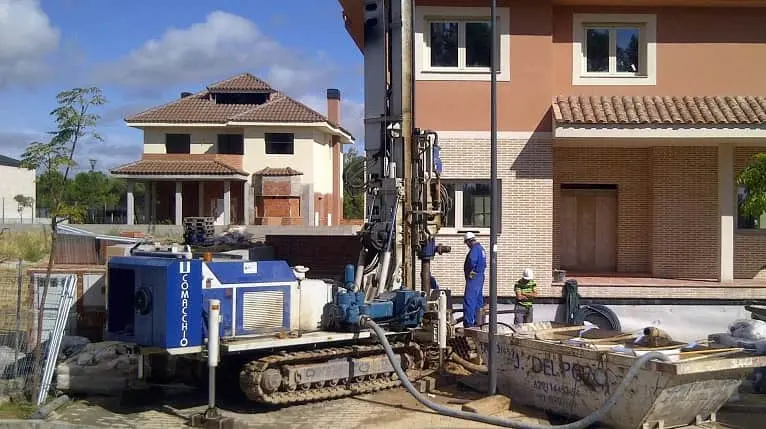
- Drilling and installation of the boreholes by approved drillers.
- Thermia heat pump, hot water tank and connection to the heating system.
- Commissioning, monitoring and maintenance.
Spanish installers have already carried out more than 1,000 installations with our equipment. A selection of projects, with their equipment and boreholes, is published in Spanish on our projects page.
Frequently asked questions
How does a geothermal heat pump work?
A closed loop of water with antifreeze runs through buried boreholes, picks up the nearly constant heat of the ground and carries it to the heat pump. The heat pump raises it to the temperature the building needs. In summer the process is reversed and the building gives heat back to the ground.
How deep are the boreholes?
In the reference projects, vertical boreholes run from 80 to 190 m. The total length depends on the building's demand and on the ground, and is calculated in the study.
How long does a geothermal installation last?
A long time, and the buried loop outlasts the machine. Replacing the heat pump does not mean drilling again: the ground loop is reused. For example, a house in Arganda del Rey had a Thermia heat pump installed in 2007 that ran for 18 years, and its replacement uses the same buried loop.
Do I need a lot of land?
Vertical boreholes take up little space: they are a few centimetres wide. That makes geothermal viable on small plots and even in urban land.
Can it cool as well?
Yes. With underfloor heating, fan coils or radiant ceilings the same installation cools in summer. Some models also offer passive cooling, which uses the ground without running the compressor.
Tell us about your project and we will tell you which system fits
The feasibility study is free and carries no obligation. We analyse the building, the ground and the heating and cooling needs.